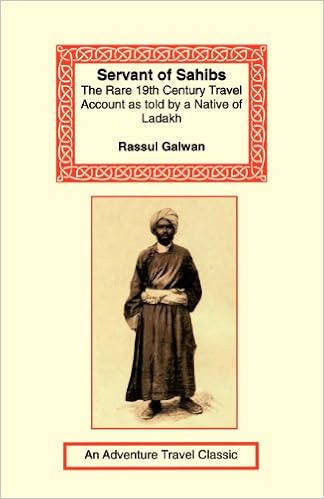
SERVANT OF SAHIBS
Had it
been a more polished book or of finer language, it would not have rung so true.
To its claim, it is considered the first book in English written by a Kashmiri.
However, our narrator, Rassul Galwan was born in Ladakh, and identifies himself
as Ladakhi and not as Kashmiri in the book. Once you take it up, it does not
matter that we are in the 21st century and that Rassul Galwan lived
and died in the one gone by. Indeed, the book he wrote is just a few years shy
of being a hundred years old.And reading it still provides an
insight into the psyche of the people in this part of the world. The
Introduction of the book by Sir Francis Younghusband opens with the words: “WHY Himalayan peoples should be as ready as
they are to undergo hardships, and run risks of the most serious nature, in the
service of any stray traveller who appears among them is not easy to understand.”
Somewhere among the pages, the book answers this puzzle. But this mysterious
question is lost in the farthest recesses of the reader’s mind as the story of
Rassul Galwan unfolds. Like any serious study of the human culture, the book
unfolds in the past of Galwan – with the story of his grandfather. The reader
is taken along on a journey through Rassul’s childhood and into his adulthood.
Along the way are stories – true to the mountains which have witnessed them,
some funny, some sad and all of them downright innocent and honest.
The narration is like how a child would narrate his best
experiences, with interest and full of lively humour. Never once does the
reader feel bored or the narrative seem slow. In every sentence, the blunt
honesty and truthfulness of the man is reflected.His intent was to write the story of “my happened” - the story
of his life. But subtly the book also holds up a window to the different worlds
he inhabited. On one side, we are introduced to the grit and determination of
his European sahibs and we get a
completely different and behind-the-scenes account of their expeditions of
which there is otherwise no or little documentation. The relationship he had
with his masters is also touching. He shows a slave’s devotion when he is ready
to die in their service, a diplomat’s political skill when he negotiates with hostile
tribes, a friend’s concern and an honest man’s integrity. One cannot fail to
imagine that he must have been more than a “servant of the sahibs”. The sahibs
did not fail to see his remarkable qualities as is evident in the Introduction
and the Editor’s Introduction.The second world he lived in was the world of a poor and common
man. He was a Ladakhi, and the scenes and events from that place and time are
painted with acute detail. His childhood years reflect how ambitious and
hardworking he was. His interactions
with other people – Kashmiris, Turkis, Chinese, Hindoos, Kashgars – are
interesting to say the least.
Throughout the narrative, one can’t help but praise the integrity and will of
this man, humble in his beginnings, humble in all his dealings, but also wise
and clever, ambitious and devoted, responsible and merry all at the same time.
The book takes us to a time gone by, a world of yore, and a journey so vividly
painted that one feels as if one is a traveller oneself.And as to the question that puzzled Sir Francis Younghusband, I
can only think of one answer after reading the book. It is the road that the
Himalayan man seeks; the thrill and fear of unknowns and the joy of travelling.
Yet, he is timid when it comes to aggression and would sooner negotiate a deal
than fight a war. All he needs is a chance to explore – he does not aim to be a
master of men. The mountains have taught him a lesson – no man is master of
another. We are all servants of the Almighty.

No comments:
Post a Comment